
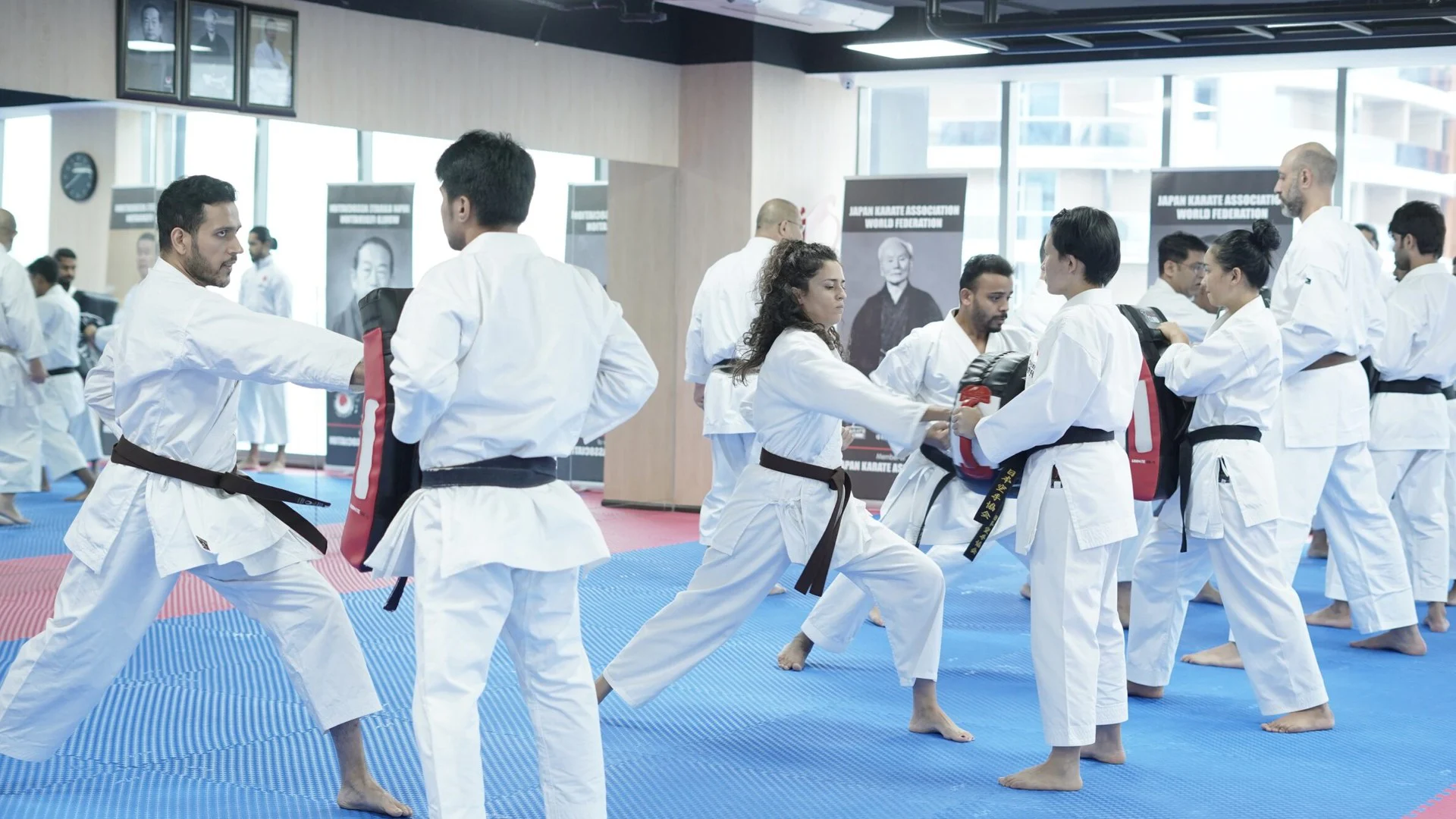
Shotokan Karate: A Complete Beginner's Guide
Shotokan is a traditional Japanese style of karate founded on the teaching of Gichin Funakoshi. Training is built on three parts: kihon (basics), kata (forms) and kumite (sparring). It is known for long, strong stances and powerful straight techniques, and students progress through coloured belts to black belt.
What is Shotokan karate?
Shotokan is one of the most widely practised styles of karate in the world. Karate itself developed in Okinawa and was brought to mainland Japan in the early twentieth century. Shotokan grew from the teaching of Gichin Funakoshi, the Okinawan master who gave the first public demonstration of karate in mainland Japan in 1922.
The name comes from Funakoshi's pen name, Shoto, meaning "pine waves", and kan, meaning "hall". His students formed the Japan Karate Association (JKA) in 1949, and the JKA remains one of the main organisations teaching Shotokan today.
The three parts of training: kihon, kata and kumite
Every Shotokan class is built from the same three elements, and every belt grading tests all three.
| What it means | What you practise | |
|---|---|---|
| Kihon | Basics | Stances, punches, blocks and kicks, repeated until they are correct and automatic |
| Kata | Forms | Set sequences of movements against imaginary opponents; Shotokan has about 26 kata |
| Kumite | Sparring | Applying techniques with a partner, from pre-arranged drills to controlled free sparring |
Basic Shotokan stances
Shotokan is known for deep, stable stances that give the techniques their power. Beginners learn these first:
- Zenkutsu-dachi (front stance): most weight on the front leg, used for attacking forward
- Kokutsu-dachi (back stance): most weight on the back leg, used for blocking and defence
- Kiba-dachi (horse-riding stance): a wide, low stance facing sideways
- Heiko-dachi and hachiji-dachi: natural ready stances used at the start and end of drills
Karate punches, blocks and kicks
Karate moves are taught one at a time in kihon, then combined. The core techniques a beginner learns are:
- Punches: oi-zuki (lunge punch) and gyaku-zuki (reverse punch)
- Blocks: age-uke (rising block), soto-uke and uchi-uke (middle blocks) and gedan-barai (downward block)
- Kicks: mae-geri (front kick), yoko-geri (side kick), mawashi-geri (roundhouse kick) and ushiro-geri (back kick)
- Strikes: shuto (knife-hand) and uraken (back-fist)
Shotokan kata for beginners
Kata are the forms of karate: fixed sequences of blocks, punches, kicks and turns, performed alone as if against several attackers. They train balance, timing, power and focus.
Beginners usually start with the five Heian kata (Heian Shodan to Heian Godan) and Tekki Shodan. More advanced students learn kata such as Bassai Dai, Kanku Dai, Jion and Enpi. Which kata you need for each belt is set by your grading syllabus.
Shotokan belts and grading
Students start at white belt (10th kyu) and work through the kyu grades to black belt (1st dan), then on through the dan grades. Each grading tests kihon, kata and kumite, and you need a minimum time at your current grade before you can grade again.
At Karate Pro, kyu gradings are examined by JKA UAE qualified examiners and dan gradings by examiners from JKA headquarters in Tokyo. The full belt order is on our belt ranking page.
The sensei, the dojo and the dojo kun
Sensei means teacher. Classes start and finish with a bow, and many Shotokan dojos recite the dojo kun, five principles that sum up the attitude karate aims to build:
- Seek perfection of character
- Be faithful
- Endeavour
- Respect others
- Refrain from violent behaviour
Starting Shotokan karate in Dubai and Sharjah
Karate Pro Academy is an official branch of the Japan Karate Association, teaching JKA Shotokan at Dubai Silicon Oasis, Al Nahda 2 in Dubai and Al Majaz 3 in Sharjah. Classes run for young children (3+), kids (4.5+), teenagers (12+), adults and ladies-only groups, led by JKA-qualified instructors.
You do not need any experience or fitness level to start. Wear comfortable sports clothes for your first class. Trials are by appointment and take place during a scheduled class for your age group: contact your nearest branch to book.